Chimney guides
Marine Air and Chimneys on the California Coast
The rainfall figures for the California coast understate how wet a chimney there actually is, because most of the moisture arrives as fog.
Short answer
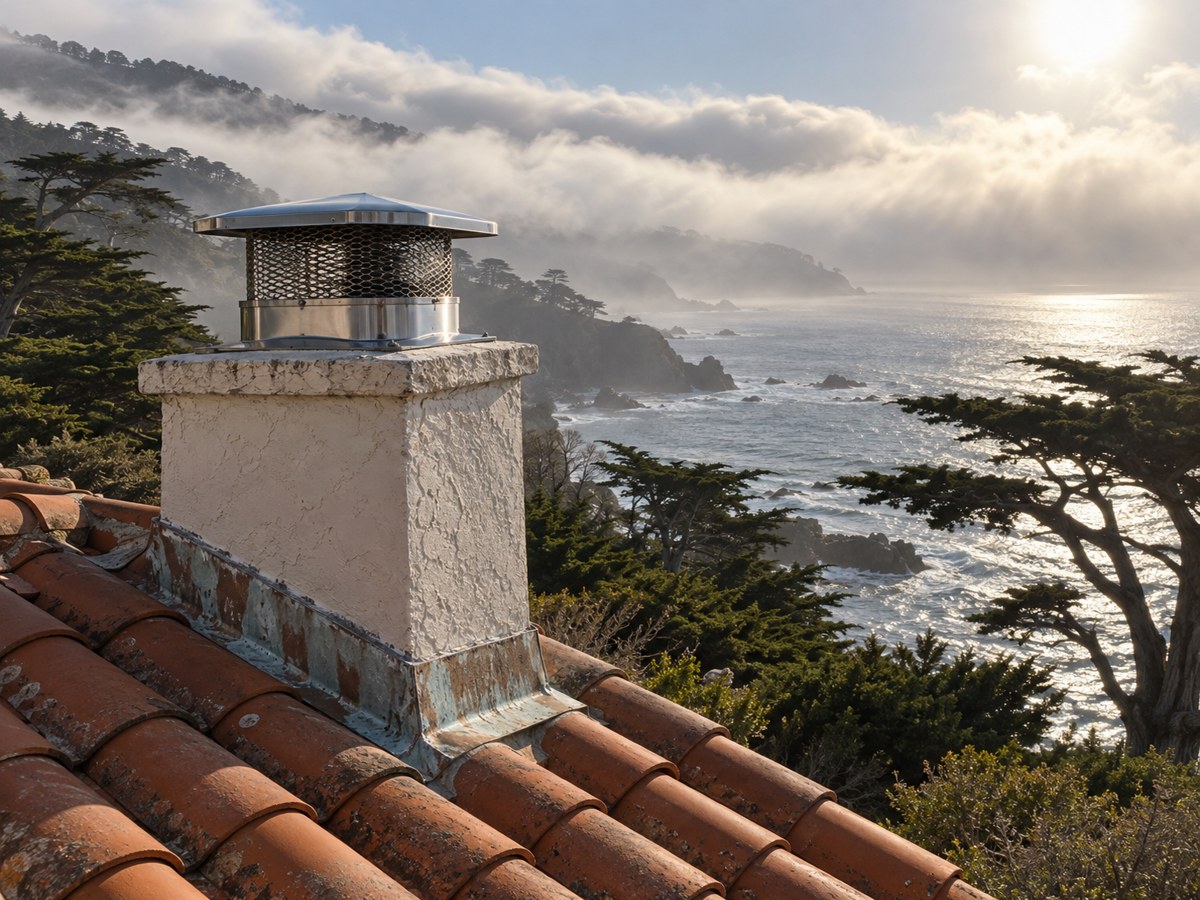
Airborne salt holds moisture against whatever it lands on, and coastal fog wets surfaces for hours without a drop of rain falling. That consumes the zinc on galvanized steel quickly and then takes the steel, and it keeps stucco and masonry damp long enough to debond render. Stainless throughout — cap, arrestor, cover and fixings — plus flashing let into a reglet rather than sealed.
Fog does as much as rain
A chimney in Pacifica, Half Moon Bay or along the Central Coast spends a large part of the year with moisture on it, and very little of that shows up in a rainfall total.
On galvanized steel the zinc coating is sacrificial by design — it corrodes so the steel underneath does not. In continuous salt-laden damp it is consumed in a few years rather than a few decades, and then the steel goes. The visible result is orange streaking down the render, which people read as the chimney failing. It is the metal on top failing and the render is what the runoff lands on.
Stainless includes the screws
A stainless cap held with plated fixings fails at the fixings. On an exposed coastal stack that means a cap that leaves in the first real blow. Ask what the fasteners are, not just the cap.
No coating substitutes for material choice
There is no product that makes a coastal chimney behave like an inland one. What works is choosing metal that does not corrode and detailing it so water cannot get behind it.
Why stucco fails faster on the coast
This is the part specific to California, because most chimneys here are rendered rather than exposed brick.
Stucco needs to be able to dry. Persistent damp behind render — from a cracked crown, from flashing, or simply from air that is wet for weeks at a time — is what breaks the bond between the render and what it is stuck to. Hollow-sounding stucco on a coastal chimney is extremely common, and it is a water problem long before it is a finish problem.
Which makes the choice of waterproofing product consequential rather than incidental. A breathable siloxane repellent lets vapor out. A film-forming sealant traps it against the substrate, and on the coast that is the fastest way to debond render.
Tap it annually
It takes a minute and it is the only early warning you get. Hollow areas need cutting back to sound material and to the lath, not skimming over.
Coastal and seismic at the same time
Much of coastal California is also fault country, so a chimney there usually needs both conversations — corrosion-resistant metalwork above, and a structural assessment of what is underneath.
The practical advice is to have one survey cover both. Splitting them into two visits costs more and tends to leave one half undone. And if the stack turns out to need rebuilding, that is the opportunity to put reinforcement and a proper tie into the framing rather than replacing like for like.
Need this done?
Coastal Chimney Protection across California
Free to use, no obligation — we never charge you.
Frequently asked questions
How far inland does marine air matter?
Further than most expect, and fog reaches well beyond the immediate shoreline. Anywhere in the coastal strip, specify stainless.
Is stainless worth the extra cost?
Near the ocean it is not really a choice — galvanized may give you a handful of years against decades for stainless, and the labor to fit either is identical.
Our stucco chimney sounds hollow. Can we just seal it?
No. That traps the water that caused it. The render needs cutting back to sound material, the cause of the water fixing, and only then a breathable repellent once it has cured.
Chimney services near you
- Los Angeles
- San Diego
- San Francisco
- San Jose
- Sacramento
- Fresno
- Oakland
- Long Beach
- Bakersfield
- Irvine
- Anaheim
- Stockton
- Riverside
- Chula Vista
- Huntington Beach
- Santa Ana
- Fremont
- Glendale
- Santa Clarita
- Modesto